
The problem with rape judgments
Rape cases have often scrutinized the survivor’s behaviour. But recent judgments show courts look for reasons to let rapists off or charge them with lesser offences


Justice B.V. Nagarathna, set to become India’s first woman chief justice in September 2027, had some marriage advice this week. “Before marriage, a boy and a girl are strangers. Whatever may be the thick and thin of their relationship, we fail to understand how they can be indulging in physical relationship before marriage.”
The two-judge Supreme Court bench of justices Nagarathna and Ujjal Bhuyan was hearing the bail plea of a man who had met a woman on a matrimonial website. He promised to marry her, had sex with her and then turned out to be already married. He then later married someone else. The woman he had met on the matrimonial site filed a complaint of rape on the grounds of “false promise to marry”.
Why had she travelled to Dubai to meet the man, justice Nagarathna asked her. Surely, if she wanted marriage, she should not have travelled before it. “These are not cases which are to be tried and convicted when there is [a] consensual relationship,” she noted.
Consent obtained from a woman based on a false promise to marry is an offense punishable by up to 10 years in jail. In 2013, a study of rape trials in Delhi’s district courts found that one in four came under this category of false promise to marry. To be sure there are problems with criminalizing “false promise to marry”. For me, it is the patriarchal assumption that a good woman would never agree to sex without marriage.
In 2024, justice Nagarathna too had observed that the break-up of a consensual sexual relationship cannot be given a criminal colour when “the said relationship does not fructify into a marital relationship”.
Rules for rape survivors
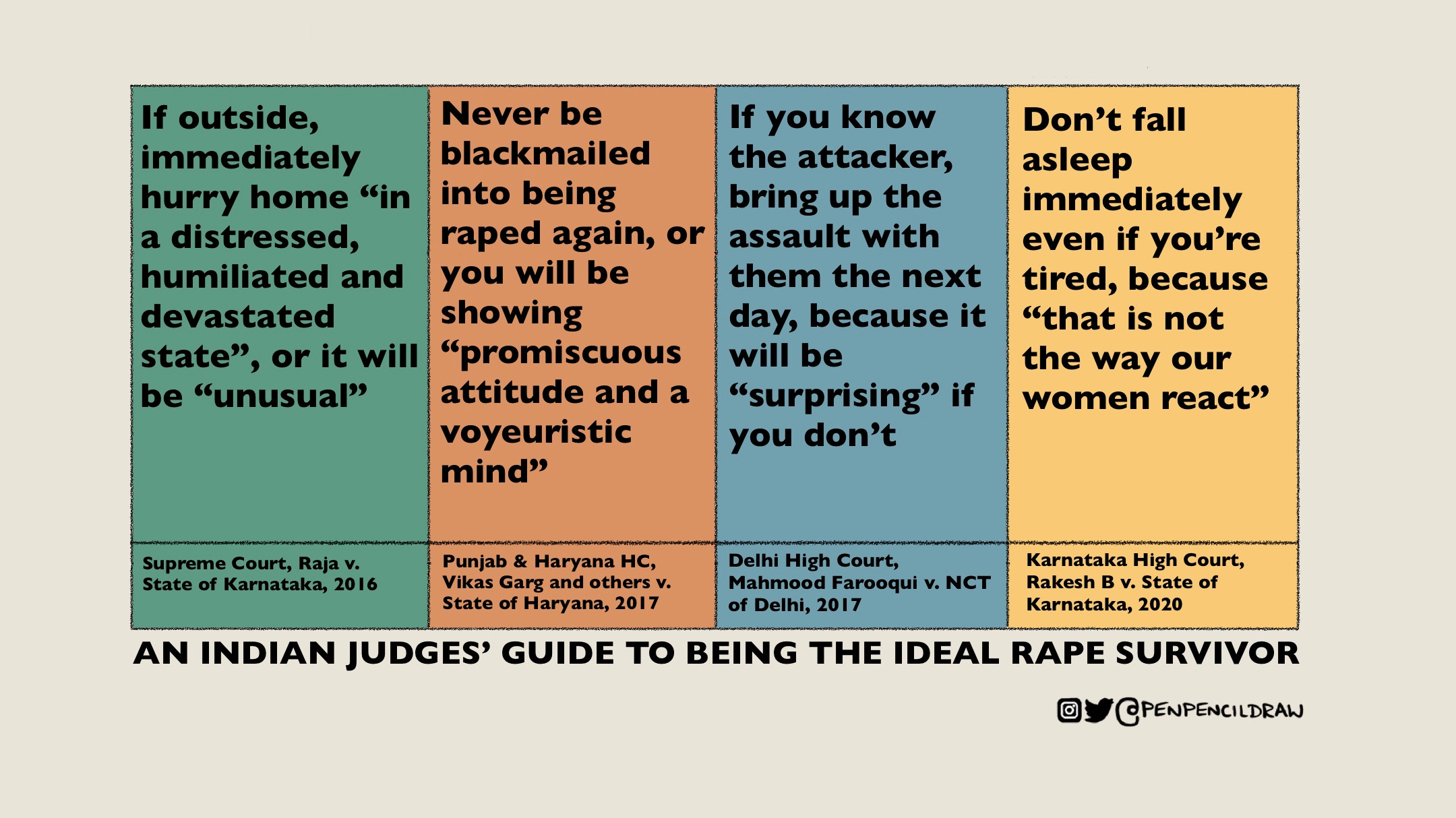
For long, rape adjudication has come packed with homilies and peppered with such florid prose as “supreme honour”, “most cherished possession of a woman”, and “unforgettable shame” that results in a “terrifying melancholia”.
This pattern goes back to the 1974 acquittal by a trial court of two policemen for raping a 16-year-old tribal girl inside the police station. It was the court’s shameful and utterly perverse reasoning that the girl was “habituated to intercourse” and so could not have been raped. This judgment was then upheld all the way to the Supreme Court where a three-judge bench noted in 1979 that there were no injuries on the girl’s body and, therefore, she could not have been raped.
In November 2025, then chief justice B.R. Gavai called the judgment an “institutional embarrassment”.
But back in 1979, the Supreme Court ruling so went against every principle of natural justice that a group of respected scholars including Lotika Sarkar and Upendra Baxi wrote an open letter. Women’s groups came out on the streets to protest. All of this led in 1983 to changes in the Evidence Act: If a woman says in court that she did not consent, the court must believe her.
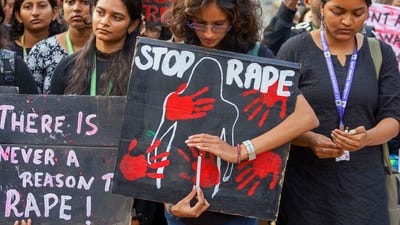
But, over four decades later, points out senior advocate Shobha Gupta, courts continue to “find fault with the woman and look for reasons to file lesser charges or completely exonerate the man.”
Earlier this week, the Chhattisgarh high court was hearing an appeal against a rape conviction by a trial court. Despite evidence of semen on the minor survivor girl’s underclothes, the high court ruled there was no evidence of penetration. Hence, there was no rape, merely an attempt to rape, a crime that carries a punishment of three years in jail instead of the minimum seven years that the offence of rape carries.
But can an actual attempt to rape be further diluted to only preparation to rape? In March last year, the Allahabad high court showed how by finding the actions by two men who dragged a minor girl under a culvert, groped her breasts, loosened the string of her pyjamas, at which point passers-by fortunately intervened and rescued her, did not amount to an attempt to rape. “In order to bring out a charge of attempt to rape, the prosecution must establish that it had gone beyond the stage of preparation,” the judge noted.
The order was so absurd, that senior advocate Shobha Gupta immediately wrote to the Supreme Court. The Supreme Court intervened and the order was overturned.
It was the Allahabad high court again that stated that a rape survivor who was a postgraduate student “herself invited trouble” by her actions that involved going to a bar, consuming alcohol and then agreeing to go to the perpetrator’s house because she was feeling unwell. Yes, she had been raped. But she should have understood the “morality and significance of her act”. In April 2025, the Supreme Court took exception to these comments cautioning judges to be careful in blaming victims.
A hyper-technical interpretation of rape law is what led the Delhi high court in December last year to rule that as an MLA, Kuldeep Singh Senger was not a public official. The distinction is important because the punishment for rape by a public official carries a tougher penalty. Senger would have remained in jail anyway on a separate charge of the custodial death of the rape survivor’s father. Yet, the interpretation of “public official” so obviously flew in the face of justice that it led to yet another public protest outside the court. The Supreme Court had to yet again step in and right a wrong.
Why would the courts go through this manner of hair-splitting law? Of focusing attention on the woman survivor rather than male perpetrator? Of imposing personal morality on women who seek nothing more than justice?
In the end, if rape adjudication is being challenged and reversed by the Supreme Court again and again, who gains? It’s certainly not survivors who face an uphill struggle to even get to the courts.
“Sometimes you think, ‘what is the point of fighting if the courts are going to come back to square one’,” says Gupta who was also the lawyer for Bilkis Bano who fought against the remission order of the men convicted of gang-raping her and killing members of her family, including her infant daughter. “But then your sense of justice kicks in and doesn’t allow you to stay silent. So, you keep on fighting.”
Chief Justice Surya Kant has labelled his predecessor DY Chandrachud’s Handbook on Combating Gender Stereotypes as “too technical” and “Harvard-oriented” to be of any real assistance to rape survivors and laypeople and has asked for another handbook to be drawn up.
It’s clear that such a handbook is desperately needed, not so much for rape survivors but also for the judges who try their cases.
In other stories

The arrest of Andrew is stunning for what is till now largely a symbolic message: No man is above the law, nope, not even the brother of a king. The arrest for “misconduct in public office” rather than raping a minor Virginia Guiffre, has left many displeased. But I’ll take what I get. Remember, Al Capone was convicted for tax evasion and not drug-related charges or prostitution, his real crimes.
Andrew’s arrest also stands in contrast to the fact that US prosecutors are yet to file charges against Americans linked to convicted sex offender Jeffrey Epstein. The fall from grace now seems complete with 95% of people polled by the Financial Times saying Andrew must be removed from the line of succession where he stands at #8.

In India, meanwhile, Bill Gates, who also features prominently in the Epstein Files, cancelled his scheduled keynote address to the India AI Impact Summit. No reason was given for the cancellation by the Gates Foundation. But Gates did receive a disgracefully grand welcome to Andhra Pradesh by chief minister Chandrababu Naidu who seemed oblivious to the PR optics of such a show of bonhomie.

Afghanistan is now the only country that legally allows men to beat their wives as long as no bones are broken. A new 90-page criminal code signed by Taliban supreme leader Hibatullah Akhundzada, shields mullahs from criminal prosecution and places women at the level of slaves who can be punished by their ‘masters’.
The Gujarat government’s reported plans to require parental consent as a pre-requisite for marriage registration flies against Constitutional guarantees of life, liberty and privacy. It also goes against judicial precedent that makes it clear that two consenting adults do not require parental or state or any other consent to marry.
Won and done? Not quite. Come April and a nine-judge Supreme Court bench will be reviewing the Supreme Court’s judgment allowing women entry into the Sabarimala shrine in Kerala. It will also simultaneously look at a basket of gender equality cases including the entry of Muslim women into mosques, the ongoing practice of female genital mutilation in the Dawoodi Bohra community, and the entry of Parsi women who marry outside their community into the Fire Temple.
The central government is backing the Sabarimala review, which is a worrying development that challenges a major, settled gender win back in 2018 when a five-judge Supreme Court bench delivered a majority 4:1 judgment allowing Hindu women the right to worship in Sabarimala where the entry of menstruating age women had been barred.
That’s it for now. I welcome feedback at namita.bhandare@gmail.com. See you again next week. Produced by Shad Hasnain.
As a law enforcer and police officer, let me share how tough it is to establish rape/harassment for dowry/domestic violence. It’s always convenient for courts to let the offender go by reading too deep into the technicalities of the law or precedences. Blanket statements such as having specific details of when incidents of assault occurred in domestic violence by husband and relatives violate logic. This practically means survivors have to keep a notebook of date, time and words used and that once is not good enough to prosecute. And even though ALL laws are misused or misread someway or the other, misogynists have ensured it is rooted in the minds of courts that most women-related cases come with her malafide intention. Thus, over scrutiny in these cases is being “cool”.